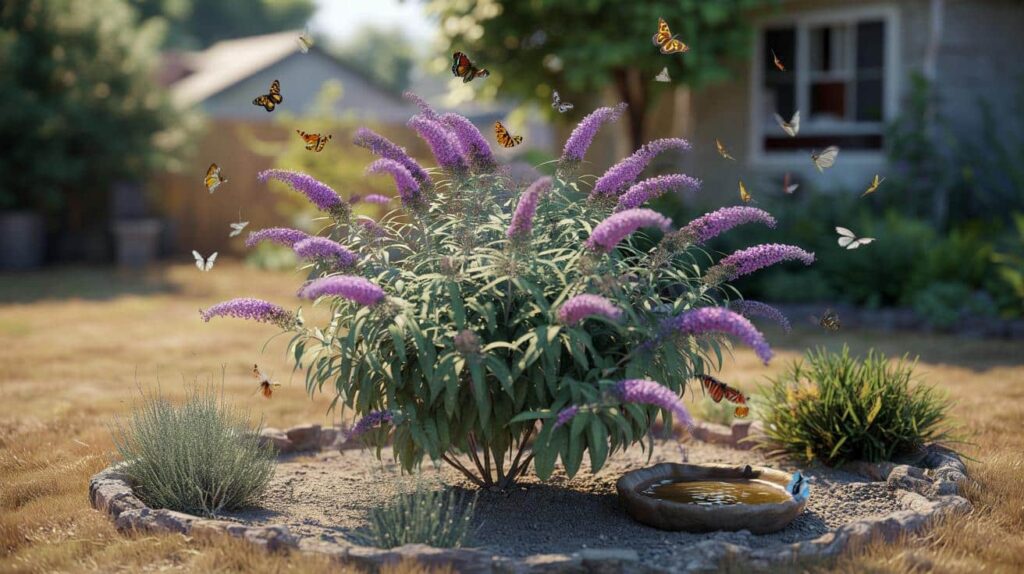
The first time I noticed the butterflies, I was standing at the kitchen window, coffee in hand, half awake. The yard was still a rough patchwork of dry grass and cracked soil, the kind of late-summer scene that makes you think the whole garden has given up. Then a flash of orange, another of deep royal blue, and suddenly the air above one lonely plant was moving like a slow, colorful storm.
They weren’t interested in the roses. They skipped the lawn completely. They hovered, dipped, and feasted on one sun-baked cluster of flowers that looked like tiny purple fountains. The plant itself hardly seemed to notice the heat. No drooping, no drama, no pleading for water from the hose.
I remember thinking: what on earth is that thing doing right?
The surprisingly tough plant butterflies adore
Ask any butterfly gardener which plant survives heat, shrugs off drought, and still throws a summer-long party for pollinators, and you’ll hear the same name again and again: butterfly bush, or Buddleja. It’s the kind of shrub that looks almost smug in the July sun, loaded with arching spikes of purple, white, pink, or even orange blooms. While other plants crisp around the edges, butterfly bush seems to double down.
Stand next to one on a hot afternoon and you’ll see why people get hooked. The blooms smell faintly honeyed, and the air above it vibrates with wings. Monarchs, swallowtails, red admirals, little cabbage whites that never sit still. The whole plant turns into a tiny airport.
A neighbor of mine, Luis, planted his first butterfly bush after a brutal heatwave burned half his perennials. He stuck a young Buddleja in the ground by the mailbox, honestly not expecting much. That first summer, the lawn browned, his hydrangeas sulked, and the water bill made him swear out loud at the kitchen table.
The butterfly bush? It grew like it hadn’t read the weather report. By August, the shrub was taller than his grade-school daughter, smothered in purple flower spikes. The mail carrier had to push past clouds of butterflies every day just to deliver letters. People began slowing their cars as they drove by, craning their necks to see what was going on.
Luis swears he watered it only three times that whole summer. The plant didn’t just survive. It basically staged a neighborhood show.
The secret is in the way Buddleja evolved. Native to rocky, sun-scorched slopes in Asia and parts of Africa, it’s built for lean living. Its roots go deep and wide, hunting for moisture most plants never reach. The leaves are often gray-green and a bit fuzzy, which helps them lose less water in strong sun. The plant’s strategy is simple: grow fast, bloom hard, and keep going until frost says stop.
For butterflies, that strategy is a jackpot. Those dense flower spikes are like multi-story nectar buffets. Each tiny floret is packed with sugar-rich nectar that’s easy to drink through a long proboscis. While many garden flowers bloom in short, polite bursts, *butterfly bush just keeps refilling the bar*.
There’s a trade-off, of course, and we’ll get to that. But for a heat-loving, low-water showpiece that calls in butterflies from blocks away, Buddleja is in a league of its own.
How to turn one shrub into a full butterfly lounge
If you want that “floating cloud of butterflies” effect, placement is everything. Butterfly bush loves sun the way cats love warm windowsills. Give it at least six hours of direct light, preferably afternoon sun where the heat really builds. That’s where it shows its true colors. Pick a spot with well-drained soil, even if it’s poor or gravelly. Rich, soggy ground is the only thing that can really sour the relationship.
Dig a hole roughly twice as wide as the pot, but not deeper, and loosen the soil around the sides. Drop the plant in at the same level it sat in its container and backfill gently. Water deeply once to settle the roots, then step back. This isn’t a needy, daily-spritz kind of plant. Deep watering every 7–10 days in the first summer is enough in most climates; after that, many established shrubs can almost coast on rainfall.
We’ve all been there, that moment when you get ambitious at the garden center and walk out with a trunk full of plants you secretly know you don’t have time to baby. Butterfly bush is the antidote to that guilty feeling. The biggest mistake new growers make is treating it like a fussy rose: too much water, too much fertiliser, too much hovering.
Buddleja responds better to a little tough love. Lightly mulch around the base, but don’t pile mulch against the stem. Skip the high-nitrogen feed that makes it tall and floppy with fewer flowers. If you live somewhere with scorching summers, a layer of gravel or light-colored stone around the plant can actually help reflect heat and keep it right in its comfort zone. Let’s be honest: nobody really does meticulous garden maintenance every single day.
“I tell people to think of butterfly bush as a summer camp cafeteria for butterflies,” says urban ecologist Maya Grant. “It’s not the only food source they need, but when it’s open, everyone shows up.”
To keep that cafeteria stylish and useful, a few simple habits help:
- Deadhead the spent flower spikes once they fade. A quick snip above a pair of leaves pushes the plant to bloom again.
- Choose modern sterile or low-seed varieties like ‘Miss Molly’ or ‘Blue Chip’ if invasive spread is a concern in your area.
- Pair butterfly bush with true host plants like milkweed, fennel, or native grasses so butterflies can lay eggs and complete their life cycle.
- Cut the shrub back hard in late winter or early spring in cold climates; it will bounce back with dense, fresh growth.
- Leave a shallow, muddy water dish nearby so butterflies can “puddle” and drink minerals between nectar stops.
Beyond the blooms: what kind of yard do you really want?
Spending time near a butterfly bush on a hot day does something subtle to your sense of what a yard is for. Instead of staring at a patch of thirsty lawn and thinking about mowing schedules, you start watching who shows up. Goldfinches picking at seed heads. Bees muscling between florets. A worn-looking monarch, its wings a bit tattered, still finding enough fuel to keep going south.
That shift can be addictive. It nudges you to trade some of that flat green carpet for layers of life: one big, tough shrub for nectar, a few scruffier host plants for caterpillars, a corner where the hose doesn’t visit all summer. The yard becomes less about control and more about hospitality.
Butterfly bush isn’t a perfect plant, and gardeners are talking more about balancing its benefits with native species and careful selection. Yet there’s something undeniably hopeful about a shrub that asks for so little and gives you a front-row seat to wild, fragile wings floating through the hottest days of the year. You plant one, thinking it’s about flowers. You look up one afternoon and realize it quietly changed how you see your whole patch of earth.
| Key point | Detail | Value for the reader |
|---|---|---|
| Drought and heat resilience | Butterfly bush thrives in full sun and poor, dry soil with minimal watering once established | Reduces maintenance, water bills, and stress during summer heatwaves |
| Butterfly magnet | Long, nectar-rich flower spikes attract a wide variety of butterflies for months | Transforms a plain yard into a lively, colorful wildlife viewing spot |
| Simple care routine | Basic pruning, occasional deep watering, and choosing non-invasive varieties | Makes it easy for busy or beginner gardeners to create a pollinator-friendly garden |
FAQ:
- Question 1What zones does butterfly bush grow in, and can it handle real heat?
- Answer 1Buddleja typically does well in USDA zones 5–9, depending on variety. Many types love hot, dry summers and will keep blooming as long as they get plenty of sun and aren’t sitting in soggy soil.
- Question 2Does butterfly bush really need very little water?
- Answer 2In its first year, it needs deep watering every week or so to establish roots. After that, many gardeners in warm climates report watering only during long droughts, especially if the soil drains well.
- Question 3Is butterfly bush invasive?
- Answer 3In some regions, old seed-heavy varieties can spread into wild areas. Many modern cultivars are bred to be sterile or low-seeding, so choosing those and deadheading spent blooms helps prevent unwanted spread.
- Question 4Does it help butterflies beyond just feeding adults?
- Answer 4Butterfly bush mainly feeds adult butterflies with nectar. To truly support their full life cycle, pair it with host plants like milkweed for monarchs, fennel or dill for swallowtails, and native shrubs for local species.
- Question 5How big does butterfly bush get, and can I grow it in a small yard or pot?
- Answer 5Traditional varieties can reach 6–10 feet tall and wide, but there are compact and dwarf forms that stay around 2–4 feet. Those smaller types can even grow in large containers with good drainage and full sun.