The sea was flat as glass when the sonar first picked up the shape. No drama, no howling wind, just a faint outline glowing on the screen of a research vessel off the coast of Western Australia. The scientists leaned in, half-bored, half-hopeful, expecting yet another rusty trawler or collapsed cargo ship. Then the contours sharpened: a wooden hull, upright on the seabed, masts still standing like fingers frozen mid-gesture.
The room went strangely quiet.
Someone whispered what everyone was afraid to say out loud: “This might be him.”
After 250 years missing, a legendary explorer’s ship had just surfaced again, not in the waves, but in pixels.
A ghost from 1770, sitting upright on the seabed
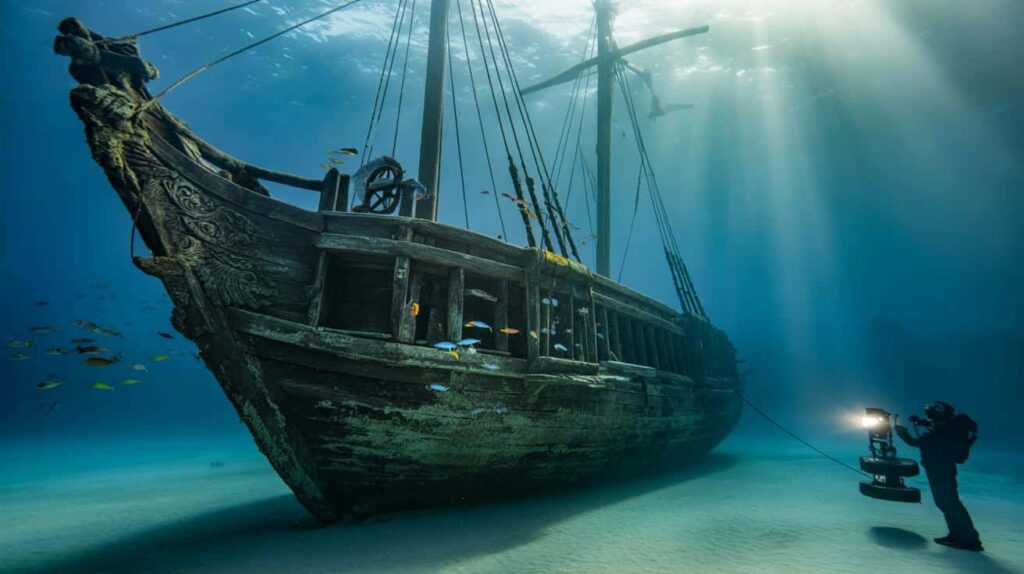
The wreck lies more than 40 meters below the surface, just far enough from the coast that you’d never suspect a time capsule was resting there. Divers who first descended describe a ship that doesn’t look ruined so much as paused. The timbers are still locked in place, the bow pointed as if it were still cutting through the Indian Ocean.
Fish move in and out of the windows where officers once argued over charts by candlelight. Barnacles crust the rails, but the carved details on the stern are still visible, softened by silt and salt. It feels less like a grave and more like a room someone left in a hurry.
When maritime archaeologist Dr. Leah Carver rolled into the water for the first dive, she says her heart was pounding so loudly she could hear it through the regulator. She followed the guide line down, watching the blue darken, then suddenly the ship emerged from the gloom in a single, impossible silhouette.
The wheel is still there. That’s what shook her. The actual wheel that once steered this ship through storms, through reefs, maybe through mutinous nights when nobody slept. She reached out and hovered her hand just above the spokes, not quite touching, knowing the oils from her skin could damage two and a half centuries of preservation. *Imagine being that close to a decision someone made in 1770.*
The reason this ship looks “perfectly preserved” is partly geography, partly luck. The wreck lies in cold, relatively low-oxygen water, deep enough that the most destructive wood-boring organisms never really took hold. Sand and silt slowly wrapped the hull like a blanket, sealing away details that sunlight and waves normally erase within decades.
Storms passed overhead, continents changed, satellites started circling the planet, and this wooden shell stayed there, undisturbed. Every nail, every knot in a rope, every crack in a plank was frozen in place by the physics of the sea. And now that we’ve found it, the race begins to learn from it without destroying the very silence that protected it.
How you search for a legend the sea has swallowed
Finding this wreck wasn’t some lucky stumble. It was a slow, grinding hunt that mixed dusty archives with high-tech scans. For years, historians cross-checked logbooks, insurance records, letters and rumor, trying to narrow down where the ship vanished. Then the oceanographers stepped in. They dragged side-scan sonar back and forth across the seabed, like mowing a lawn nobody had seen before.
Scan after scan, they cataloged blobs, shadows, odd shapes. Most of them: modern junk. One of them: a hull from another world. The method is painfully repetitive, the kind of work that only pays off once every few careers. Let’s be honest: nobody really signs up for maritime archaeology because they love spreadsheets.
One of the big turning points came from something almost embarrassingly simple: a misread place name in an 18th-century report. A young researcher rechecked a smudged page from a port authority book and realized the coordinates everyone had been using were about 30 nautical miles off. That tiny correction shifted the search zone into deeper water, an area that had never been scanned properly.
Within six months, the sonar engineer noticed a form on the screen that was too symmetrical, too clean to be a natural rock. Rigging shadows. Hull curvature. A bow angle that matched the explorer’s ship almost perfectly. Suddenly, all those dry hours in an archive turned into the moment a lost world appeared in grainy grayscale.
This discovery is also a reminder of how fragile certainty can be. For decades, experts were convinced the ship had broken apart on a reef closer to shore. Textbooks, museum panels, even TV documentaries repeated that version. The ocean didn’t argue. It just kept the real story 40 meters down, waiting for someone to look in the right spot.
That’s the quiet lesson here: what we “know” about the past often depends on which pieces we’ve found and which we haven’t. A single wreck, suddenly visible, can rearrange the map in our heads. It can move the line between myth and documented fact by a few kilometers, a few planks, a single name carved into a beam.
How you open a 250-year-old time capsule without breaking it
Once the wreck was identified, the hardest part began: touching almost nothing. The initial dives felt more like a medical operation than an adventure. Divers used laser scanners and photogrammetry, slowly circling the hull, taking thousands of overlapping images. Each tiny gesture was deliberate. One misplaced fin kick could stir up a cloud of silt and hide the site for hours.
On deck, specialists stitched those images into a 3D model so detailed you can zoom in on individual nail heads. This digital double will guide every future move on the wreck. Before anyone even thinks of lifting an object, they’ll “test” the operation virtually, watching how the structure might respond to the loss of a beam or cannon.
The temptation, of course, is to grab the dramatic things first: the officer’s chest, the captain’s table, maybe a navigational instrument that still holds fingerprints under its corrosion. That’s where teams often make mistakes. They rush, pulled by the thrill of display cases and headlines. Then the site collapses in on itself, losing the context that gave every artifact its story.
Here, the lead conservators are openly cautious. They talk about decades, not seasons. They tell politicians and sponsors that the “good TV moment” will come slowly, in small pieces. They also speak to local communities about shared ownership, to avoid the old pattern where a European ship is found in Australian waters and the narrative gets shipped back overseas in the next container.
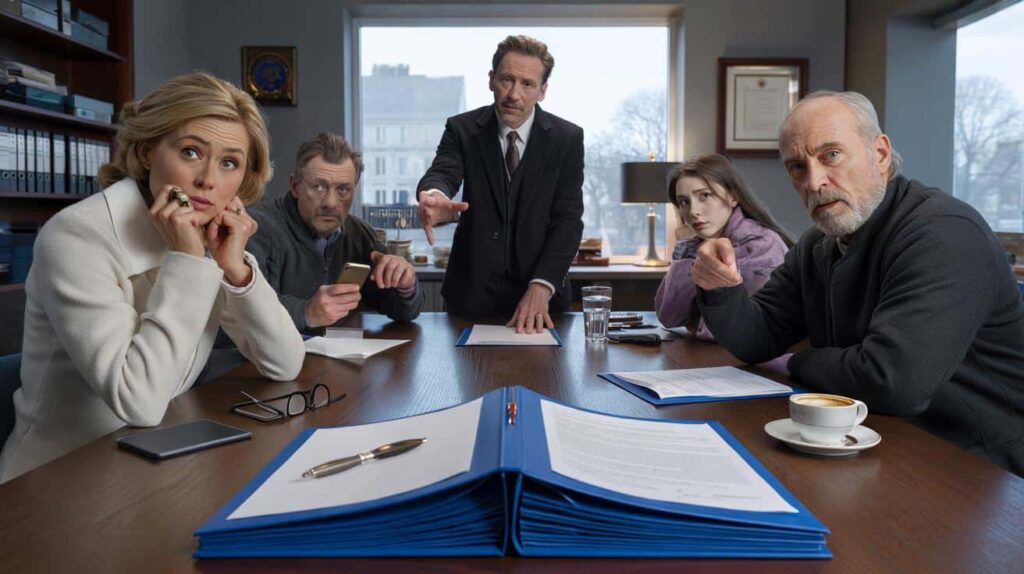
At one planning meeting, Dr. Carver reportedly pushed back against pressure to recover the figurehead quickly, calling it “the emotional heart of the wreck.”
“We’re not just raising objects,” she said. “We’re raising relationships: between crew members, between empires, between the ship and this coastline. If we rip its heart out first, what kind of story are we telling?”
- Go slowly, even when the story is big: fast extractions look heroic, but they often erase data that only becomes valuable years later.
- Work with, not against, local memory: coastal communities may hold oral stories and place names that fill gaps in ship logs.
- Keep a digital twin alive: 3D models let millions “visit” the wreck without stressing the real structure.
- Share the uncertainty: admitting what isn’t known invites the public into the investigation instead of closing the case too early.
- Protect the silence: some sites should remain partly untouched, an underwater archive that future technology might read more gently than we can today.
A mirror from the age of sails to the age of satellites
Standing on the deck above the wreck, you’re hit by a strange overlap of centuries. GPS screens glow, drones buzz overhead, and just beneath the hull of the research vessel lies a ship that once navigated by stars and dead reckoning. The explorer who commanded it drew coastlines no European had seen before, sending back maps that rewired global trade and empire. Now his ship surfaces again in another kind of empire: data, imagery, viral stories shared in seconds.
This isn’t just about one vessel, or one famous name finally pinned to a co-ordinate. It’s about how we choose to remember the era that launched so many of the world’s present-day tensions and connections.
For some Australians, this wreck is a symbol of first contact, the moment foreign flags began edging into skies that had always belonged to someone else. For maritime buffs, it’s a dream come true: a wooden encyclopedia of 18th-century shipbuilding and navigation. For climate scientists, the timber and sediments trapped inside may hold clues to ocean conditions long before modern measurements began.
And for anyone who has ever stared out at the horizon and wondered what’s out there, it’s proof that the sea still keeps secrets, even in an age when we think every coastline has been Street-Viewed to death.
We’ve all been there, that moment when a forgotten object at the back of a drawer suddenly throws you back years in a heartbeat. This wreck is that sensation, multiplied by centuries. It asks awkward questions about who got to be called an “explorer” and who was already here, watching unfamiliar sails appear on the line between water and sky. It also offers a rare chance to pause and listen, before rushing to package the past as content.
Some finds shout. This one, sitting upright in the dark, seems almost to whisper: there’s more to the story you think you know.
| Key point | Detail | Value for the reader |
|---|---|---|
| Perfect preservation | Cold, deeper water and silt shielded the hull from decay for 250 years | Helps you picture how an 18th-century ship really looked and worked |
| Search method | Blend of archival research and advanced sonar mapping over a corrected search zone | Shows how patient, layered investigation can overturn long-held assumptions |
| Careful excavation | Digital 3D modeling and slow, collaborative recovery strategy | Reveals why protecting context matters more than quick, spectacular finds |
FAQ:
- Question 1Whose explorer’s ship is this, exactly?Researchers are still being cautious with formal announcements until every detail is verified, but all current evidence points to a major 18th-century European expedition vessel long believed lost off Australia’s west coast.
- Question 2Can the public visit the wreck?Direct dives by tourists are extremely unlikely due to depth, fragility and legal protections, yet detailed virtual tours based on 3D scans are expected to be made available online and in museums.
- Question 3Will the ship ever be raised to the surface?Full recovery of the entire hull is improbable, since lifting and conserving such a structure would be incredibly risky and expensive; targeted retrieval of selected artifacts is far more realistic.
- Question 4What kinds of objects might be found on board?Archaeologists hope to find personal belongings, navigation tools, weaponry, ceramics, food remains, and construction details that can refine our understanding of life at sea in the 1770s.
- Question 5Why does this discovery matter today?It sheds new light on the early encounters that shaped modern Australia, challenges old narratives about exploration, and offers a rare, intact scientific archive locked inside a single, silent ship.