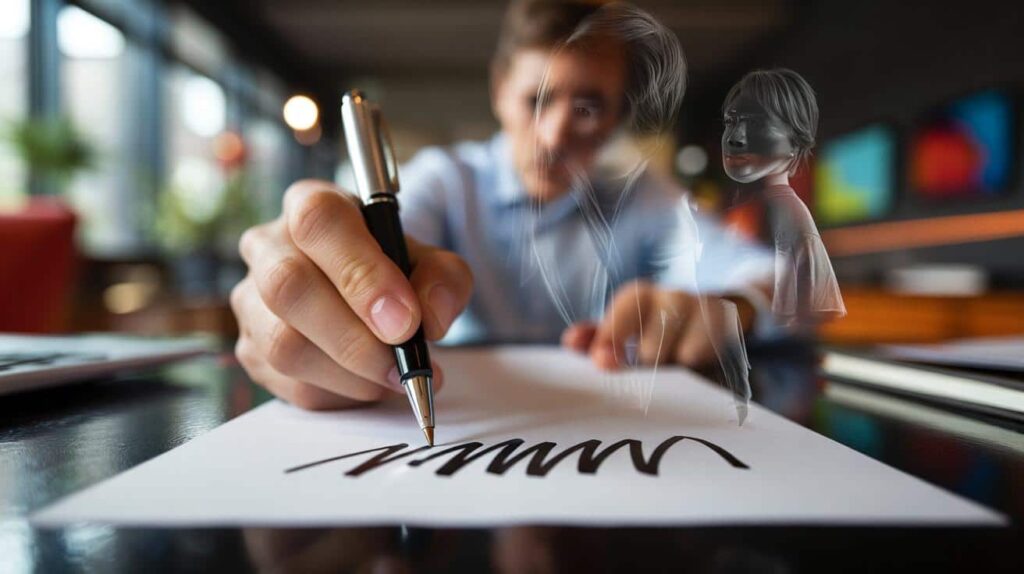
You’re at the bank, or signing for a parcel, and the clerk spins the receipt toward you. You scribble your name, almost without looking. A small flourish, a straight line, a dramatic swoop under your surname. It takes less than two seconds. You pass the pen back, walk out, forget about it.
A few hours later, that signature is sitting on a server, quietly revealing who you are. Or at least, who you think you are.
Psychologists say the tiny underline you draw under your name might be saying more than you’d ever dare say out loud.
The secret message hiding in that little line
Most of us learn to sign our name as teenagers and never touch it again. The movement becomes automatic, like tying your shoes. Still, that quick underline is loaded. The length of the line, how close it sticks to your name, whether it curves up or down – all of this sends subtle signals about your relationship with yourself.
Specialists in handwriting analysis, including some personality researchers, see the underline as a kind of “highlighter” for the ego. When you underline your name, you aren’t just decorating letters. You’re quietly announcing how central you feel you are in the story.
Picture two signatures on a lease. The first: “Anna J.”, written simply, no extras, no drama. The second: “MARCUS LEE” in big slanted letters, with a long, sharp underline that shoots forward like an arrow, even climbing slightly at the end.
Marcus may not say “I’m ambitious” out loud, but his pen does. Studies on signature size and embellishments often link bolder signatures to higher self-confidence and status-seeking. One large review on signatures and personality even found that executives tend to sign bigger, with more underlines and loops, than the rest of us. The signature turns into a tiny billboard for the self.
Psychologically, an underline is like putting your name on a pedestal. You separate it from the rest of the text, almost as if you’re lifting yourself off the page. When that line sits very close to your name, it can signal a strong need for self-protection or recognition, a “this is me, don’t overlook it” impulse. A long underline stretching far beyond the last letter suggests projection into the future, drive, or a desire for influence.
On the other hand, no underline at all doesn’t mean no personality. It can reflect a grounded, more discreet self-image. Or simply a choice to blend in, to keep things functional rather than expressive. The line – or its absence – becomes a quiet map of how loudly you’re willing to exist on paper.
How to read your underline without overthinking it
Before you dive into self-analysis, grab a piece of paper and sign your name three times without slowing down. Don’t pose, don’t “perform” your signature. Just write like you would at the delivery guy’s door. Then look closely at the underline.
Is it straight, wavy, nervous, super long, or almost invisible? Does it start before the first letter or after it? Does it touch the last letter or float away? This little check-up is less about judging yourself and more about noticing patterns. *You’re basically watching your hand tell the truth your mouth might dress up.*
A common trap is to see one trait and panic. You spot a long underline and think, “Oh no, I’m arrogant.” Or you see a tiny, broken line and hear, “So I lack confidence?” Breathe. We’ve all been there, that moment when one line of pop-psych advice suddenly feels like a diagnosis.
Real psychologists warn that a signature alone cannot define your personality. It can hint, suggest, raise questions. Nothing more. Context matters: your culture, your job, even the documents you’re signing. You might sign more boldly on a contract than on a birthday card. Let’s be honest: nobody really does this every single day. Most of the time, we just sign and hope the pen works.
“Handwriting and signatures are like selfies of the mind: revealing, but never the full picture,” says a psychologist who studies identity and self-expression in everyday gestures.
- A strong, straight underline
Often associated with determination, a solid sense of self, and a clear “I’m here” attitude. It can also hint at a need for control or structure. - An underline that curves upward at the end
Commonly linked to optimism, drive, or ambition. The pen literally lifts your name toward the future, like a small graphic of hope. - A broken, shaky, or very short underline
Sometimes seen in people who feel less secure or are in a moment of doubt. It can also show modesty, a “no need to show off” stance. - Underline starting before the first letter
Can suggest anticipation and readiness, a tendency to prepare before acting, or a desire to “set the stage” before entering. - Underline extending far beyond the last letter
Often read as a need for influence, visibility, or recognition that stretches beyond the present moment or current circle.
What your underline says about who you want to be
Once you’ve looked at your signature, a more surprising question appears: does your underline reflect who you are, or who you’d like to be? A lot of people quietly redesign their signature over time without noticing it. After a breakup, a career shift, or a move abroad, the way they sign can change – the line gets bolder, or disappears, or suddenly curves.
Psychologists talk about the “ideal self”, that personal version 2.0 we’re always chasing. Your underline often flirts with that ideal. It’s like a tiny audition for the character you’re trying to grow into.
If your underline feels “too much” for who you are today, that doesn’t make it fake. It can be a kind of rehearsal. A shy person might adopt a more assertive flourish, hoping their hand will drag their personality forward. Someone who has always felt invisible might stretch that line far across the page, as if carving space where they were once squeezed small. On the flip side, people who’ve spent years in hyper-competitive environments sometimes simplify their signatures as a quiet rebellion against ego overload.
That change can be incredibly freeing. A stripped-down line – or none at all – becomes a way of saying, “I don’t need to shout my name to exist.”
There’s another layer too: culture, family, and the signatures we copy when we’re young. You may have unconsciously borrowed your underline from a parent, a teacher, or a celebrity whose autograph you admired. That little line might carry memories, loyalties, even unresolved expectations.
So the next time your pen slides under your name, you can ask yourself: whose story am I signing here? Is this my voice, or someone else’s echo? The answer isn’t found in a rigid rule or a graphology chart. It sits in the gentle gap between your hand, your history, and the person you’re still becoming.
| Key point | Detail | Value for the reader |
|---|---|---|
| Underline style reflects self-image | Length, shape, and placement of the line offer clues about confidence, ambition, and desire for recognition | Helps you notice how you present yourself, even in tiny everyday gestures |
| Signatures evolve over time | Life changes, emotional shifts, and new roles can subtly change your underline | Encourages you to track personal growth through something you do automatically |
| Not a diagnosis, but a prompt | Psychology views the underline as one cue among many, not a final verdict on your character | Lets you explore your personality with curiosity instead of self-criticism |
FAQ:
- Does underlining my name mean I’m narcissistic?
Not automatically. An underline can signal confidence or a wish to be seen, but true narcissism involves a broader pattern of behavior. The signature is only one small clue.- Can I change my personality by changing my signature?
Altering your signature won’t magically rewrite your character, yet it can support a new mindset. A more grounded or assertive underline can act as a daily reminder of the person you’re trying to become.- Is graphology scientifically proven?
Classic graphology (reading full personality from handwriting) is widely criticized in scientific circles. Some specific aspects, like signature size and embellishments, show limited correlations with traits, but they’re never used alone for serious assessment.- Why do I sign differently at work and in private?
Many people adopt a “public” signature that looks more formal or powerful, and a softer, quicker one for personal use. Each version expresses a different role or social mask.- What if I don’t underline my name at all?
That’s just as meaningful. It can reflect a practical, modest, or low-drama way of being. Or it simply means you like things clean and uncluttered on the page. No underline doesn’t mean no personality.