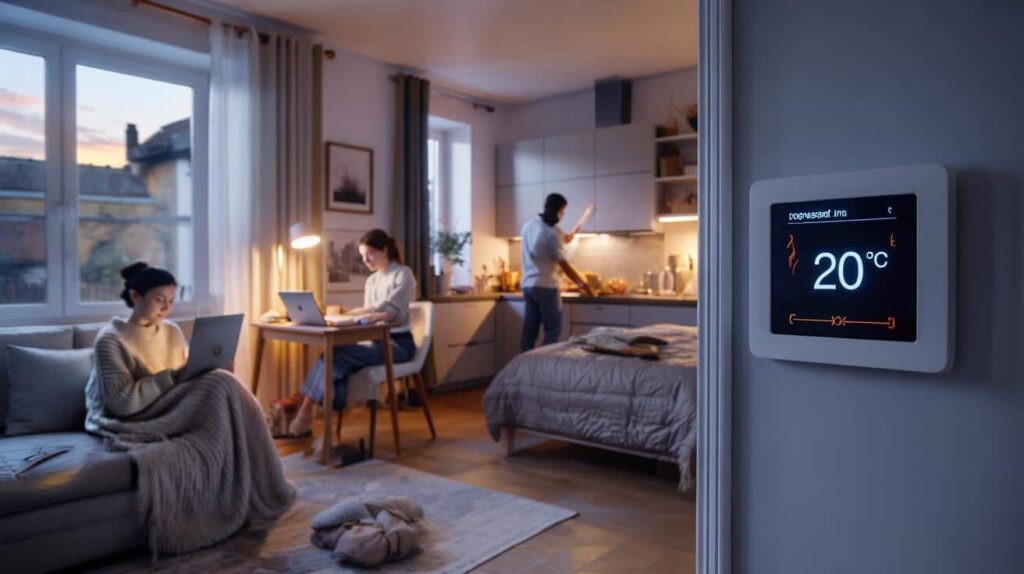
The scene repeats itself every winter. You walk into a friend’s apartment, shivering from the street, and they say with a proud smile: “I’m keeping it at 19 °C, it’s what we’re supposed to do.” You peel off your coat, sit down on the sofa… and your toes start to freeze. A little later, someone discreetly bumps the thermostat up a notch when nobody’s looking.
For years, 19 °C has been held up like a moral temperature. The “good citizen” setting. The number you’re supposed to quote if anyone asks. Yet more and more experts are saying something else: this magic figure no longer matches how we live, work and age today.
Something is quietly shifting behind our radiators.
The 19 °C dogma meets real life
The 19 °C rule was born in a very different world. Oil crises, poorly insulated buildings, radiators banging in the night. Governments needed a simple, one-size-fits-all number to promote energy savings, and 19 °C sounded strict but bearable.
Today, our homes are better insulated, our lifestyles are more sedentary, and remote work means we spend entire days indoors. That old recommendation starts to feel like wearing a winter coat chosen for someone else’s body.
Experts now talk less about a single “ideal” temperature and more about comfort ranges, room by room, body by body.
Take the story of Julie, 34, who started working from home in a renovated flat in Lyon. In the first winter, she stuck religiously to 19 °C. She had read it everywhere, so she felt almost guilty touching the thermostat. By January, she had permanent neck tension and frozen fingers on her keyboard.
One day, after a video call where she appeared wrapped in a blanket, her doctor laughed and told her: “You’re not in a government memo, you’re in your living room. Warm up.” She slowly moved to 20.5 °C in her office, kept the bedroom cooler, and noticed she was more focused and less tense.
Her energy bill barely changed, but her daily life did.
What experts see now is simple: at 19 °C, many people are just… cold. Especially older adults, children, people with circulatory issues or those who don’t move much. Our bodies don’t all react the same way.
Studies on thermal comfort show that most people feel at ease between 20 °C and 22 °C in living areas, with lighter clothing and low physical activity. Below that, the body compensates, tenses up, burns energy to stay warm. Over the course of weeks and months, that constant chill can impact sleep, mood and even the risk of falls in seniors.
Energy sobriety is still crucial. But freezing on the sofa is not a sustainable climate policy.
The new recommended temperatures, room by room
So what do experts suggest now? Not one sacred number, but a small, flexible grid. In living rooms and home offices, many specialists now lean towards **20–21 °C** as a reasonable target for most people. It’s the balance where comfort improves clearly while consumption doesn’t explode.
For bedrooms, the picture is different. Sleep doctors still recommend cooler air, around 17–18 °C for adults in good health. The trick is to heat the bed, not the whole room: good duvet, hot water bottle, maybe a thicker pair of socks. Kitchens often stay comfortable around 18–19 °C because cooking appliances add heat. Bathrooms sit in their own category, with recommendations creeping up to 22–23 °C at shower time, even if only for short periods.
Many households already live by these “secret rules” without naming them. Heat the living room a bit more in the evening. Turn up the bathroom radiator ten minutes before a shower. Let the bedroom cool down after opening the window. These micro-adjustments draw a picture that has nothing to do with a flat 19 °C across the board.
Energy agencies themselves are quietly updating their messages. You’ll see charts suggesting 20 °C for living rooms, a notch more for seniors, a notch less for sporty types. Some public health experts even warn that stubbornly staying at 19 °C for frail people can be counterproductive, increasing the risk of respiratory infections and joint pain.
The watchword is no longer “one number for all”, but “the lowest comfortable temperature for you”.
Behind these new ranges lies a shift in mindset. Instead of saying “19 °C is moral, the rest is wasteful”, experts now ask: at what point does the body start to suffer, and the bill start to surge? The answer is not a cliff, but a slope.
Roughly speaking, each extra degree means 6–7% more heating consumption in a typical home. Moving from 19 °C to 20.5 °C in your main room might cost you a little more, yet dropping rarely-used rooms to 16–17 °C or improving insulation can offset that easily.
Let’s be honest: nobody really does this every single day. But the goal is to get closer, not to be perfect.
Finding your real comfort point without blowing up the bill
One simple method is to “walk” your thermostat slowly, instead of jumping straight from 19 °C to 22 °C. Pick your main living area and raise the temperature by 0.5 °C for three days. Observe your body: hands, feet, shoulders, sleep quality. Then nudge another 0.5 °C if needed, or step back if you feel sluggish. Somewhere between 19 and 22 °C, most people feel a clear break between “enduring” and “living”.
Do this room by room. Your home office may need 20.5 °C, while the hallway can stay at 17 °C. Use doors as thermal borders. The goal is not to heat every cubic meter equally but to create islands of comfort where you actually spend time.
The biggest trap is trying to compensate for cold radiators with electricity-hungry habits. Electric fan heaters running all evening, baths that turn into mini-spas, ovens left open to warm the kitchen. They bring a quick sense of relief and a slow, painful surprise when the bill arrives.
Another frequent mistake is ignoring small drafts. A poorly sealed window or an uninsulated door sill can make 20 °C feel like 18 °C on the skin. People react by cranking up the thermostat, when a simple draft stopper or a thicker curtain would change everything. *The body reads comfort through air movement and surfaces as much as through the number on the screen.*
We’ve all been there, that moment when you add a second sweater instead of admitting the house is just under-heated.
“Thermal comfort is not a moral score, it’s a health parameter,” says one building physicist. “We need to stop shaming people who heat to 21 °C and start asking why some homes still leak so much heat at 19 °C.”
- New comfort range for living areasMost experts now recommend 20–21 °C for living rooms and home offices, especially for people who are sedentary or sensitive to cold.
- Cooler bedroomsFor healthy adults, 17–18 °C in the bedroom supports better sleep, with the warmth focused on bedding rather than the air.
- Short, targeted boostsBathrooms and baby changing areas can go up to 22–23 °C, but only for short periods instead of being heated all day.
- Personal adjustmentsOlder adults, babies and people with chronic conditions may need 1 °C more than these averages for real comfort.
- Priority to insulationSealing drafts, insulating windows and using thick curtains often saves more energy than obsessing over half a degree on the thermostat.
From “good” temperature to fair temperature
The debate around 19 °C was never just about physics. It touches on guilt, money, health, even generational differences. Grandparents who grew up in cold houses sometimes see cold as a virtue. Younger people working all day at a laptop ask why they should type with numb fingers for the planet. Somewhere between those positions lies a shared interest: staying warm enough without wasting energy we can’t afford, financially or ecologically.
The new expert recommendations don’t erase 19 °C, they put it in context. For some, 19 °C in the living room is perfectly fine. For others, **21 °C is not a luxury, but a basic need**. The real question becomes: what is the fairest temperature for your body, your home, your bill, your climate impact?
That’s a conversation to have at the kitchen table on a cold evening, thermostat in sight, hands wrapped around a mug, negotiating not just degrees, but a way of living together through winter.
| Key point | Detail | Value for the reader |
|---|---|---|
| 19 °C is no longer a universal rule | Experts now talk about comfort ranges, not a single ideal number | Gives permission to adjust heating without guilt while staying responsible |
| Room-by-room strategy | 20–21 °C in living rooms, cooler bedrooms, warmer bathrooms for short periods | Helps reduce bills while improving everyday comfort and sleep |
| Small actions beat strict numbers | Insulation, draft proofing and targeted heating often save more than 1 °C less on the thermostat | Offers practical levers that feel achievable and effective |
FAQ:
- Is 19 °C still recommended anywhere?Yes. For well-insulated homes and healthy, active adults, 19 °C in living areas can remain comfortable, especially if you move around and wear warm clothing. It’s still a good reference for energy sobriety, just not an absolute rule.
- What temperature do experts now recommend for the living room?Most specialist bodies point to a band between 20 °C and 21 °C for living rooms and home offices, with the lower end for active people and the higher end for sedentary or more vulnerable occupants.
- What about bedrooms for children and babies?For babies and small children, many pediatric recommendations hover around 18–20 °C, with adapted clothing and sleep sacks. The air should not be too hot or too dry, and overheating is more risky than a slightly cool room.
- Does raising the heating by 1 °C really change the bill?On average, one extra degree on the thermostat increases heating consumption by about 6–7%. The actual impact depends on your insulation, energy source and how often you heat, but the order of magnitude is real.
- How can I feel warmer without raising the thermostat too much?Focus on three things: block drafts (doors, windows, vents), improve surfaces around you (rugs, curtains, throws) and target heat where you stay still (workstation, sofa, bed) with local solutions like blankets or heated cushions.